Start with the number. Eighty-seven Tokyo artists sit in the Athenoir emerging index. Nairobi holds 165. Istanbul holds 155. Jeddah, a city with roughly one one-hundredth of Tokyo's gallery infrastructure by any honest count, holds 107. Tokyo comes in below Doha and level with Casablanca. If you have spent any time walking from Roppongi down through Nogizaka, cutting east to the Kiyosumi warehouses, or climbing the narrow staircases of Ginza's tenant buildings where a two-room gallery has occupied the same floor since the Bubble, that number should feel wrong. It isn't wrong. It is the point.
Tokyo is the clearest working example in our research index of a mature market that has declined to become a large one. Every element of a deep art economy is present: a century of dealer lineage, a domestic collector base with real memory, museum programming that treats postwar Japanese practice as a canon rather than a rediscovery, auction houses that clear regional inventory without needing to import spectacle. What is not present, in the proportions the infrastructure would predict, is a churning bench of new names.
This is not a failure. It is a choice, distributed across thousands of small decisions by dealers, schools, and artists themselves, and it produces a city that reads very differently from the emerging capitals currently dominating the Athenoir index. The Middle East, Africa and Asia together form the majority of our emerging tier. Nairobi and Istanbul are the visible engines. Tokyo, by contrast, behaves like a city that has already decided what emergence is for and priced it accordingly.
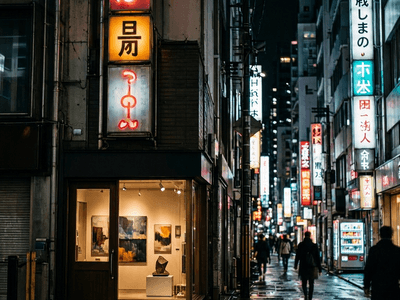
Walk Ginza on a Saturday. The rhythm has not changed in decades: a solo show opens, runs three weeks, closes, the wall text goes into a bound catalogue that the gallery will still be selling to a specific collector in ten years. The artist may be thirty-two or seventy-two. The framing is identical. There is no separate emerging-artist vitrine, no project space bolted onto the main room, no attempt to signal that this work is early and therefore provisional. A young painter in Ginza is shown the way a mid-career painter is shown, which means fewer young painters are shown, which means the emerging count stays modest.
Cross the river to Kiyosumi-Shirakawa and the register shifts but the underlying logic holds. The warehouse galleries that anchor the district run programmes deep enough to feel like small institutions. An artist enters that ecosystem slowly, often after years of group presentations elsewhere, and once inside is expected to hold the space. The infrastructure is generous. The entry point is narrow.
Roppongi and Tennozu operate on a third clock, closer to international art-fair time, and this is where the eighty-seven begin to appear in visible concentration. But even here the pattern of the city asserts itself. A Tokyo emerging show tends to arrive fully built: edition sizes decided, pricing coherent across a body of work, the artist's practice already narrowed to one or two of the fourteen mediums our index tracks rather than the omnivorous four-or-five-medium spread common in the emerging cohorts of Lagos or Dakar. Installation, painting, drawing, mixed media, photography, sculpture, watercolour, performance, collage, ceramics, sound, AI, generative, video — the emerging tier globally splits itself across all of them in near-equal share. Tokyo emerging practice, in our reading, tends to commit earlier.
Which brings us to price. Across the full Athenoir emerging index, roughly two thousand artists post entry prices below five thousand dollars, and the majority of the tier sits below fifty thousand. Tokyo's eighty-seven cluster in the higher of those bands more consistently than the global distribution would suggest. This is not scarcity pricing. It is the residue of a gallery culture that has, for a long time, refused to sell early work as cheaply as early work is sold elsewhere, on the argument that a first serious painting is not a lesser object than a fifth one. Whether one agrees with the argument is beside the point. The argument has shaped the city.
Compare this to what the same index shows at the top of the market. The established tier holds 1,643 artists globally: 43 ultra-blue-chip, 543 blue-chip, 616 established, 441 mid-career. Painting dominates that tier at 130 practitioners, sculpture follows at 69, installation at 58. The established distribution is narrow and traditional. The emerging distribution is wide and technological — AI art and generative art together account for over four hundred emerging practices in our count, against sixty in the established tier. Most cities in the emerging index are visibly straddling that gap, trying to build local versions of both futures at once. Tokyo is doing something stranger. It is running an emerging scene that looks, in medium distribution and pricing behaviour, more like a junior established tier than like the volatile experimental fields of Alexandria or Accra.
The honest guide to the city, then, is not a route. It is an adjustment of expectation. Do not go to Tokyo looking for the volume of new names that Istanbul or Nairobi will put in front of you in a weekend. You will not find it, and the search will make you miss what is actually there: a small cohort of artists who have been placed inside an unusually patient infrastructure, whose first shows are treated as first shows and not as auditions, and whose dealers are, in most cases, still the same people who will represent them in twenty years.
This has costs. A city that admits eighty-seven emerging artists into serious circulation is a city that is not admitting several hundred others who, in Jeddah or Beirut or Sharjah, would already be shown. The Tokyo model is conservative in the specific sense that it conserves. It preserves gallery lineages, collector relationships, catalogue standards, and a certain idea of what a first solo exhibition should look like. It does so by keeping the door narrow.
The question the city puts to the rest of the Athenoir index is uncomfortable and worth sitting with. Nairobi's 165 and Istanbul's 155 are, in part, a function of infrastructure racing to catch up with talent. Tokyo's 87 is a function of infrastructure that long ago decided it did not need to expand in order to be serious. Both are legitimate answers to the question of what an emerging scene is for. Only one of them is currently fashionable to admire.
Spend a week in the Ginza staircases and the Kiyosumi warehouses and the Tennozu upper floors and you will understand why the fashion is wrong, or at least incomplete. Depth is not the same as volume. A mature market is not obliged to be a large one. Tokyo, quietly, has been demonstrating this for longer than most of the cities above it on our list have had a contemporary gallery scene at all.