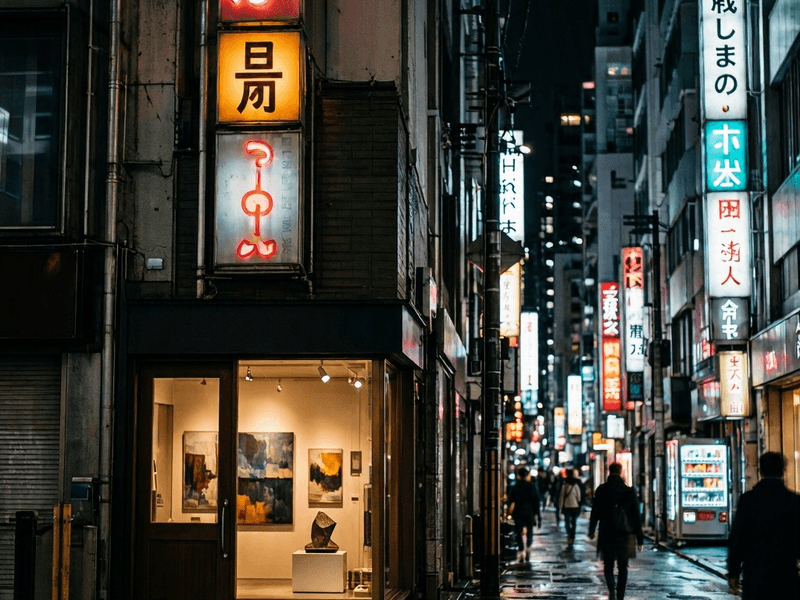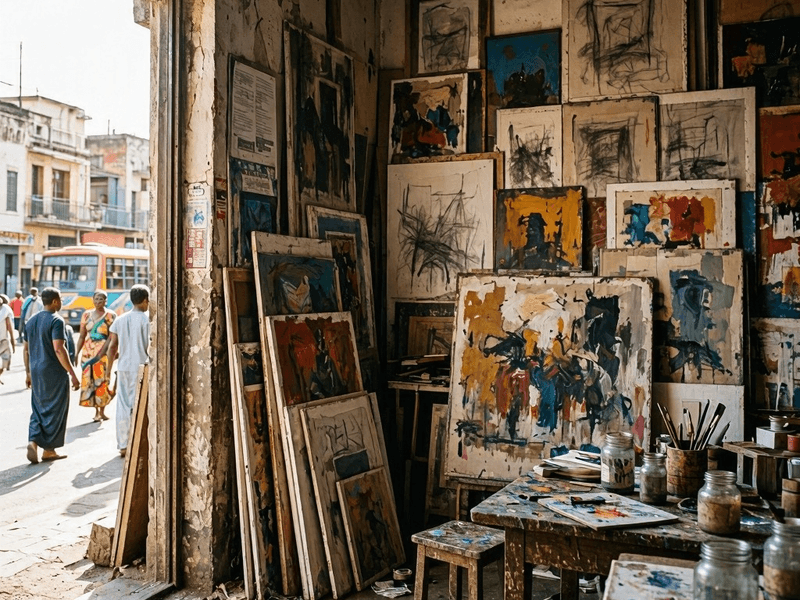
The first thing to understand about Tel Aviv is that the calendar is shorter here. Mandatory service takes its years at the front. Rent takes its years at the back. The domestic collector base is small enough that everyone in it can be named at a single dinner. Between those pressures sits a working life, and the Athenoir index counts 101 emerging artists compressing entire careers into it — the exact same cohort size as Ankara, a city with none of the same constraints.
One hundred and one is not a small number. It places Tel Aviv in the upper tier of our emerging index, above Riyadh, Abu Dhabi, Dubai, above Tokyo and Shanghai, within sight of Jeddah. What separates it from those peers is not scale but tempo. There is no slow decade here to squander on figuring out what the work wants to be. The work has to know already.
Walk south from the old port and the studios begin to stack. Florentin, Kiryat HaMelacha, the industrial edges of Jaffa where a converted mechanic's bay costs what a converted mechanic's bay costs anywhere now — which is to say, too much, and rising. Artists here talk about square metres the way people elsewhere talk about grant deadlines. The lease is the medium behind the medium.
What gets made under that pressure has a particular grain. Look at the practices our index records most often among emerging artists globally: installation, painting, drawing, mixed media, photography, sculpture, watercolour, performance, collage, ceramics, sound art, AI art, generative art, video art — a spread so even it reads as a refusal of hierarchy. Tel Aviv's cohort sits inside that spread but leans, anecdotally and unmistakably, toward the practices that survive relocation. Work that can be rolled, shipped, emailed, reinstalled in a Berlin project space or a Lisbon apartment gallery the month after it debuts here. Compression teaches portability.
The city's painters are the most legible example. Painting remains, per our index, the single most common practice among established artists worldwide — 130 of 1,643 — and the second most common among the emerging, at 250. In Tel Aviv the medium arrives already knowing this. There is no naive painting in the studios I have seen described; there is painting that understands it is entering a saturated field and behaves accordingly. Smaller formats. Denser surfaces. Fewer gestures per canvas, each one asked to justify the wall it will eventually hang on somewhere else.
Sculpture and ceramics tell a related story. The Athenoir index shows 232 emerging sculptors and 211 ceramicists globally, and both practices demand exactly what Tel Aviv rations: space, time, kiln access, a landlord's tolerance. That the city still produces sculptors at all is a minor act of defiance. That it produces them with the frequency our researchers encountered suggests something about the willingness to build heavy things in a place that will eventually ask you to move them.
Then there is the other pole — the practices that need no square metres at all. AI art and generative art together account for 421 entries in our emerging database, sound art another 213, video 209. These are the disciplines a compressed career can actually afford. A laptop is a studio. A hard drive is an archive. An artist who begins service at eighteen and emerges into a rental market at twenty-three can build a serious generative practice in the interval without ever signing a commercial lease. The index does not break this out by city, but the logic is structural, and Tel Aviv is one of the places where the logic bites hardest.
The market that receives all of this is, by international standards, thin. A handful of galleries carry most of the visible weight. The museums acquire when they can. Private collections are serious but finite. What this produces is an early and unsentimental relationship with export. Tel Aviv artists learn the shipping crate before they learn the vernissage. The fair calendar in Basel, Paris, Miami, Seoul is read here as infrastructure, not aspiration. A career that cannot leave the city cannot really be a career.
This is where the compression begins to look, if not like an advantage, at least like a discipline. Consider entry prices across our emerging index: roughly two thousand artists list a lower bound under $5,000, and the majority of the entire emerging database sits below $50,000. Tel Aviv's cohort lives inside those bands. The pricing is not a strategy. It is a description of what a young artist in a small market can ask for and receive. What it means for anyone encountering the work is that the first serious acquisition from a Tel Aviv studio is, materially, within reach.
The temptation is to read all of this as hardship narrative. It is not. The Athenoir index is not a sympathy document. What the numbers describe is a city that, per capita against its constraints, is producing artists at a rate comparable to capitals many times its size and stability. One hundred and one emerging practices, held against the 165 our researchers found in Nairobi or the 155 in Istanbul, is a serious showing from a metropolitan area of under half a million in the core municipality. The density of practice per available working year is, arguably, the highest in the index. We have not calculated it. We do not need to. Anyone who has visited a Florentin studio building on a Friday afternoon knows the arithmetic.
What gets made when there is no slow decade to waste is work that has already answered its own first questions. The Tel Aviv studios our researchers encountered were not full of experiments waiting to become something. They were full of finished positions — small, sometimes, and often unresolved at the edges, but committed at the centre. The compression forces commitment. You cannot afford the year of ambivalence. You cannot afford the second MFA. You cannot afford to wait until the market notices, because the market that would notice is nine time zones away and does not know your building exists.
So the artists here behave as if noticed already. They make the work at the scale it will be seen at. They price it at the level a first international buyer can actually meet. They build practices portable enough to survive the flight and durable enough to justify it. One hundred and one of them are in our index now. The next hundred and one are already in the studios above them, working on a shorter clock than almost anyone else we counted, and producing, against every structural reason not to, at full volume.