Somewhere between the studio and the jury, a paragraph intervenes. It arrives in a font chosen by a template, sits above a link to images no one will look at until the paragraph has done its filtering, and quietly determines whether a life's work advances to the next round. It is called the artist statement. It is a genre now, with its own conventions, its own cadence, its own approved verbs. And it has learned to speak louder than the work.
Consider what it actually is. Two or three hundred words of theory-inflected prose in which an artist must gesture toward their practice without describing it, invoke the political without committing to a politics, and thread a needle between confidence and the correct register of self-effacement. The verbs are known: interrogates, destabilises, unsettles, negotiates, holds space for. The nouns arrive in the correct order: bodies, archives, thresholds, ecologies, hauntings. Somewhere a materiality is being foregrounded. Somewhere a binary is being troubled. The sentences hum with a low theoretical current borrowed from graduate seminars two decades old, translated and re-translated until the original arguments have been sanded off and only the tone remains.
This is not language. It is a passport stamp.
The stamp is required at every border. Grant applications. Residency portals. Gallery submissions. Open calls. Museum acquisition committees. Every gate that stands between an artist and the possibility of being seen has installed the same customs booth, and the customs officer asks the same question in the same dialect. Speak it well and you are waved through to the room where your work might, eventually, be looked at. Speak it poorly and your images are never opened.
The cruelty of this arrangement is that the dialect is not the artist's first language. For a great many practitioners in a globally scattered field, it is not their second or third language either. An artist working in a small city far from the anglophone centres, whose visual thinking is precise and whose English is functional, is asked to perform fluency in a register that native English speakers themselves had to be trained into. The training happens in specific rooms, in specific programmes, in specific cities, taught by people who learned it in the same rooms a generation earlier. It is a guild language pretending to be a universal one.
And so the statement becomes a class filter dressed as a curatorial tool. It selects, quite efficiently, for artists who have spent time near the seminar rooms where the dialect is transmitted. It selects for artists whose institutions taught them to write about themselves in the third person of critical theory. It selects for artists who can afford, in time and money, to hire someone to write it for them, and there is now a small quiet economy of ghostwriters who will produce the paragraph for a fee, in the correct register, with the correct verbs. The paragraph is a commodity. The dialect can be purchased. This is not a scandal at the edges of the system. This is the system working as designed.
Meanwhile the work sits in a folder, unopened.
There is a deeper injury underneath the practical one. The artist statement asks the artist to be their own critic, their own curator, their own translator, their own theorist, and to perform all four functions before the work has been permitted to speak for itself. It reverses the natural order of encounter. A viewer should meet the object first and the explanation second, if at all. The statement collapses this sequence into a single pre-emptive gesture. The artist arrives already glossed. The work arrives already framed. Whatever surprise the object might have generated has been anticipated and defused by its own maker, who has been forced to describe, in the correct dialect, what the work is doing before anyone has been allowed to decide whether it is doing anything at all.
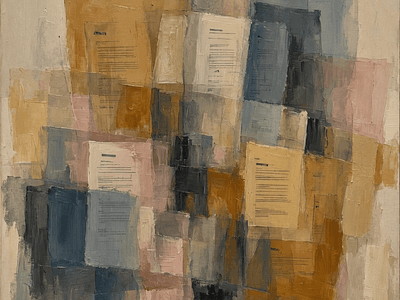
The honest artists resist this. You can feel it in the statements that flinch, that try to be plain, that refuse the verbs. These statements are usually punished. Plainness reads, to a tired juror scanning fifty applications in an afternoon, as a lack of seriousness. The dialect is a shorthand for competence. Its absence looks like an absence of thought. In reality the opposite is often true: the artist who writes plainly is the one who trusts the work to arrive on its own terms, and the artist who writes fluently in the dialect is often the one who has learned that the dialect is what actually gets funded.
What is lost is impossible to count and easy to feel. Somewhere an artist has stopped applying. Somewhere a body of work is being made without any hope of the customs booth waving it through, and so the work does not travel, does not get seen, does not enter the conversations where it might have changed something. The paragraph did that. Not the jury, not the taste of the moment, not any single decision. The paragraph, standing at the gate, asking for papers in a language the artist never agreed to learn.
The defenders of the statement will say it is necessary. Juries are overwhelmed. Something must do the initial sorting. The statement, they will say, is at least a text the artist wrote themselves, a small window into their thinking. This defence assumes that the text is authored freely, in a language of the artist's choosing, at a length that suits the work. None of these assumptions survive contact with an application portal, which specifies the word count, implies the register, and rewards the dialect. What the jury reads is not the artist thinking. It is the artist ventriloquising the gate.
Abolition is probably impossible. The infrastructure is too deep, the habit too old, the convenience for institutions too great. But the genre can be exposed for what it is, and its authority can be weakened. A juror can decide, privately, to read the statement last, or not at all. An institution can accept work in the artist's first language, without translation, and pay for the translation itself if translation is needed. A gallery can look at the images before it looks at the paragraph, and notice how often the paragraph has been doing work the images did not need done. A writer can refuse, in their own practice, to reproduce the dialect, and refuse to demand it of others.
The work was supposed to be the argument. The paragraph was supposed to be a courtesy. Somewhere along the way the courtesy became the argument, and the argument became a rumour attached to it. The field will not recover its seriousness until the paragraph is returned to its proper size: small, optional, and quiet enough that the work can be heard over it.